The Kenya National Union of Teachers (KNUT), once the most powerful and influential teachers’ union in the country, has staged a remarkable comeback after years of decline that nearly rendered it irrelevant.
From the brink of losing its recognition status to reclaiming its voice nationally, regionally, and globally, KNUT’s revival highlights how leadership change, institutional reforms, and social dialogue can restore a battered trade union.
The union’s lowest point came during the tenure of former Secretary-General Wilson Sossion. Under his leadership, KNUT was engulfed in perennial wrangles with the Teachers Service Commission (TSC), particularly with its former chief executive Nancy Macharia.
The confrontational relationship between the union and the employer eroded trust, alienated teachers, and triggered mass resignations from the union.
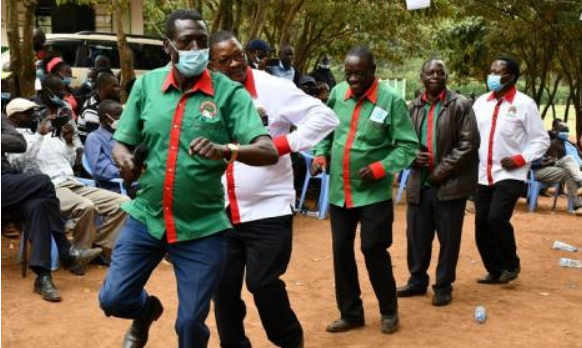
KNUT officials led by Secretary General Collins Oyuu at a past event. PHOTO/Courtesy.
By 2020, as KNUT headed into its 2021 elections, membership had dipped dramatically from about 189,000 to just 9,600, something that had severe legal implications. Labour law requires a union to command the support of at least 50 per cent plus one of the workforce it represents to qualify for a recognition agreement.
With membership at rock bottom, the TSC, acting within the law, issued KNUT with a notice revoking its recognition agreement, effectively stripping the union of its bargaining power.
The union was also weighed down by Sh301 million in accrued tax arrears owed to the Kenya Revenue Authority (KRA), in addition to millions of shillings owed to various lawyers engaged to handle the numerous cases pending in court. At the height of the crisis, auctioneers moved in and carted away furniture from the KNUT headquarters.
KNUT secretary general Collins Oyuu, speaking during the Union’s 65th Annual Delegates Conference at Kasarani Stadium, described that period as the darkest chapter in the union’s history.
“That was the sad situation we were in at the time simply because there was no mutual understanding between the employer and the union, but we are here today doing very well with the TSC,” Mr Oyuu said.
Today, the union boasts of a membership nearing 170,000, a dramatic rebound that places it within reach of reclaiming its full recognition status.